Assignment #2 -- Experiencing the Shift From Left to Right
 Posted: Mon Oct 18, 2010 2:00 pm
From the book:
Friends, we have 3 drawings for this exercise.
VASES-FACES DRAWING #1
Before you begin: First, read all the directions for the exercise.
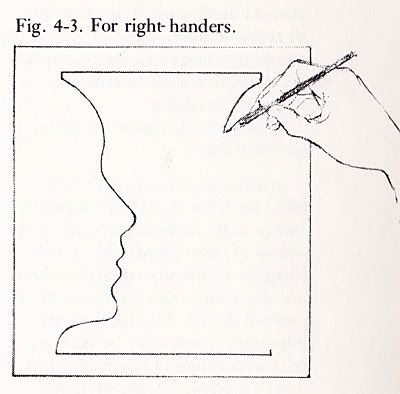
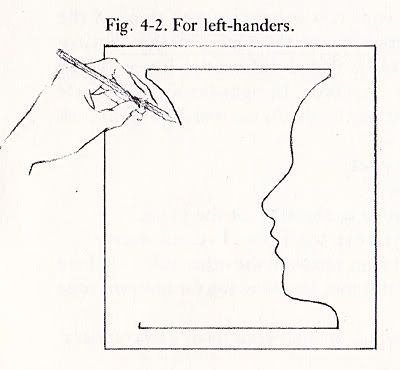
1. Draw a profile of a person's head on the left side of the paper, facing toward the center. (If you are left-handed, draw the profile on the right side, facing toward the center.) Examples are shown below of both the right-handed and left-handed drawings. Make up your own version of the profile if you wish. It seems to help if this profile comes from your own memorized, stored symbols for a human profile.
2. Next, draw horizontal lines a the top and bottom of your profile, forming top and bottom of the vase.
3. Now go back over your drawing of the first profile with your pencil. As the pencil moves over the features, name them to yourself: forehead, nose, upper lip, lower lip, chin, neck. Repeat this step at least once. This is an L-mode task: naming symbolic shapes.
4. Next, starting at the top, draw the profile in reverse. By doing this, you will complete the vase. The second profile should be a reversal of the first in order for the vase to be symmetrical. Watch for the faint signals from your brain that you are shifting modes of information processing. You may experience a sense of mental conflict at some point in the drawing of the second profile. Observe this. And observe how you solve the problem. You will find that you are doing the second profile differently. This is right-hemisphere-mode drawing.
VASES-FACES DRAWING #2
THE BAROQUE VASE & MONSTER FACE
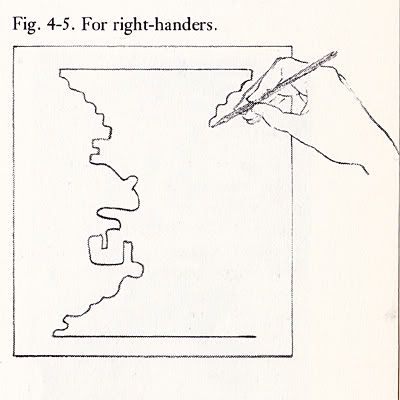
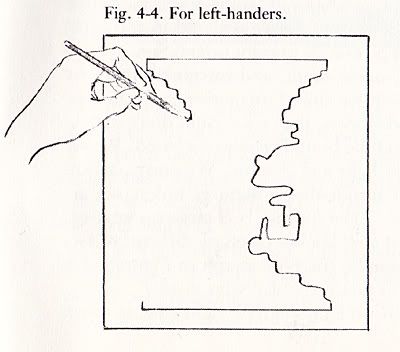
1. On the left side of the paper if you are right-handed, or the right side if you are left-handed, draw a profile. This time draw the profile of the oddest face you can conjure up -- a witch, a ghoul, a monster. Again, name the parts of the face as you go down the profile, naming also whatever embellishments you add, such as wrinkles, moles, double chins, etc. Examples are provided below, but make up your own profile if you wish.
2. After you finish this first profile, add the horizontal lines at the top and bottom for the vase.
3. Now draw the profile in reverse, completing the vase, this time a baroque vase.
UPSIDE-DOWN DRAWING
Before you begin: Read all of the following instructions.
1. Find a quiet place to draw where no one will interrupt you. Play music if you like. As you shift into R-mode, you may find that the music fades out. Finish the drawing in one sitting, allowing yourself about thirty to forty minutes -- more if possible. Set an alarm clock or a timer, if you wish, so that you can forget about keeping time (an L-mode function). And more importantly: do not turn the drawing right side up until you have finished. Turning the drawing would cause a shift back to L-mode, which we want to avoid while you are learning to experience the R-mode.
2. Look at the upside down drawing provided below for a minute (I can e-mail anyone a larger, printable version if you would prefer -- send me a PM). Regard the angles and shapes and lines. You can see that the lines all fit together. Where one line ends another starts. The lines lie at certain angles in relation to each other and in relation to the edges of the paper. Curved lines fit into certain spaces. The lines, in fact, form the edges of spaces, and you can look at the shapes of the spaces within the lines.
3. When you start your drawing, begin at the top and copy each line, moving from line to adjacent line, putting it all together just like a jigsaw puzzle. Don't concern yourself with naming the parts; it's not necessary. In fact, if you come to parts that perhaps you could name, such as the h-a-n-d-s or the f-a-c-e (remember, we are not naming things!), just continue to think to yourself, "Well, this line curves that way; this line crosses over, making that little shape there; this line is at that angle, compared to the edge of the paper," and so on. Again, try not to think about what forms are and avoid any attempt to recognize or name the various parts.
4. Begin your upside-down drawing now, working your way through the drawing by moving from line to line, part to adjacent part.
5. Once you've started drawing, you'll find yourself becoming very interested in how the lines go together. By the time you are well into the drawing, your L-mode will have turned off (this is not the kind of task the left hemisphere readily takes to: it's too slow and it's too hard to recognize anything), and your R-mode will have turned on.
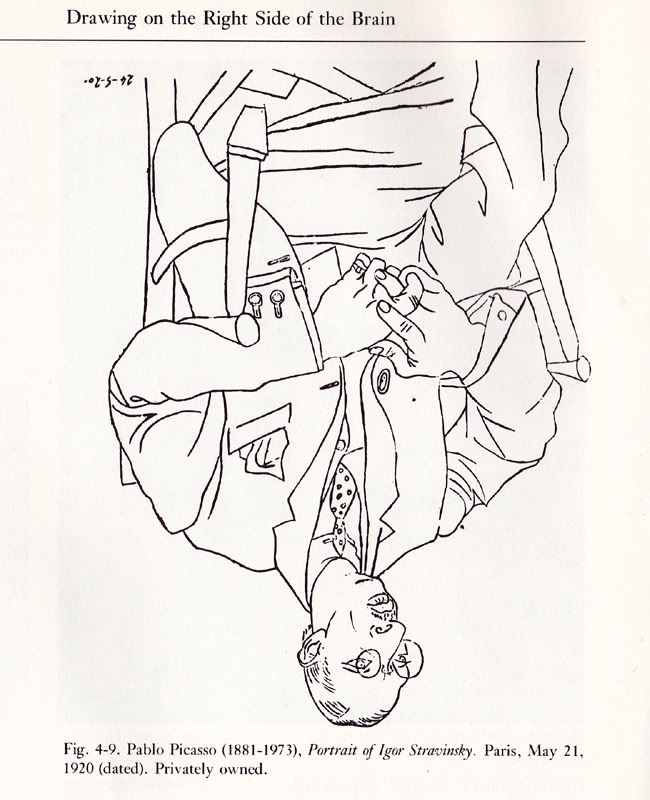
Moderator note: If you should choose to use a different reference for your Upside-Down Drawing, if at all possible post it along with your assignment!
Alright, let's all experience The Shift.
Drawing a percieved form is largely a right-hemisphere function. This has now been empirically tested and documented. As I have explained, to draw a perceived form we want the left mode mainly "off" and the right mode "on," a combination that produces a slightly altered subjective state in which the right hemisphere "leads." The characteristics of this subjective state are those that artists speak of: a sense of timelessness, difficulty in using words or understanding spoken words, a feeling of confidence and a lack of anxiety, a sense of close attention to shapes and spaces and forms that remain nameless.
It's important that you experience the shift from one mode to the other -- the shift from the ordinary verbal, analytic state to the spatial, nonverbal state. By setting up the conditions for this mental shift and experiencing the slightly different feeling it produces, you will be able to recognize and foster this state in yourself -- a state in which you will be able to draw.
...
The exercises that follow are specifically designed to help you shift from your dominant left-hemisphere mode to your subdominant R-mode. I could go on describing the process over and over in words, but only you can experience for yourself this cognitive shift, this slight change in subjective state. As Fats Waller once said, "If you gotta ask what jazz is, you ain't never gonna know." So it is with R-mode state: you must experience the L- to R-mode shift, observe the R-mode state, and in this way come to know it.
Friends, we have 3 drawings for this exercise.
VASES-FACES DRAWING #1
Before you begin: First, read all the directions for the exercise.
1. Draw a profile of a person's head on the left side of the paper, facing toward the center. (If you are left-handed, draw the profile on the right side, facing toward the center.) Examples are shown below of both the right-handed and left-handed drawings. Make up your own version of the profile if you wish. It seems to help if this profile comes from your own memorized, stored symbols for a human profile.
2. Next, draw horizontal lines a the top and bottom of your profile, forming top and bottom of the vase.
3. Now go back over your drawing of the first profile with your pencil. As the pencil moves over the features, name them to yourself: forehead, nose, upper lip, lower lip, chin, neck. Repeat this step at least once. This is an L-mode task: naming symbolic shapes.
4. Next, starting at the top, draw the profile in reverse. By doing this, you will complete the vase. The second profile should be a reversal of the first in order for the vase to be symmetrical. Watch for the faint signals from your brain that you are shifting modes of information processing. You may experience a sense of mental conflict at some point in the drawing of the second profile. Observe this. And observe how you solve the problem. You will find that you are doing the second profile differently. This is right-hemisphere-mode drawing.
VASES-FACES DRAWING #2
THE BAROQUE VASE & MONSTER FACE
1. On the left side of the paper if you are right-handed, or the right side if you are left-handed, draw a profile. This time draw the profile of the oddest face you can conjure up -- a witch, a ghoul, a monster. Again, name the parts of the face as you go down the profile, naming also whatever embellishments you add, such as wrinkles, moles, double chins, etc. Examples are provided below, but make up your own profile if you wish.
2. After you finish this first profile, add the horizontal lines at the top and bottom for the vase.
3. Now draw the profile in reverse, completing the vase, this time a baroque vase.
UPSIDE-DOWN DRAWING
Before you begin: Read all of the following instructions.
1. Find a quiet place to draw where no one will interrupt you. Play music if you like. As you shift into R-mode, you may find that the music fades out. Finish the drawing in one sitting, allowing yourself about thirty to forty minutes -- more if possible. Set an alarm clock or a timer, if you wish, so that you can forget about keeping time (an L-mode function). And more importantly: do not turn the drawing right side up until you have finished. Turning the drawing would cause a shift back to L-mode, which we want to avoid while you are learning to experience the R-mode.
2. Look at the upside down drawing provided below for a minute (I can e-mail anyone a larger, printable version if you would prefer -- send me a PM). Regard the angles and shapes and lines. You can see that the lines all fit together. Where one line ends another starts. The lines lie at certain angles in relation to each other and in relation to the edges of the paper. Curved lines fit into certain spaces. The lines, in fact, form the edges of spaces, and you can look at the shapes of the spaces within the lines.
3. When you start your drawing, begin at the top and copy each line, moving from line to adjacent line, putting it all together just like a jigsaw puzzle. Don't concern yourself with naming the parts; it's not necessary. In fact, if you come to parts that perhaps you could name, such as the h-a-n-d-s or the f-a-c-e (remember, we are not naming things!), just continue to think to yourself, "Well, this line curves that way; this line crosses over, making that little shape there; this line is at that angle, compared to the edge of the paper," and so on. Again, try not to think about what forms are and avoid any attempt to recognize or name the various parts.
4. Begin your upside-down drawing now, working your way through the drawing by moving from line to line, part to adjacent part.
5. Once you've started drawing, you'll find yourself becoming very interested in how the lines go together. By the time you are well into the drawing, your L-mode will have turned off (this is not the kind of task the left hemisphere readily takes to: it's too slow and it's too hard to recognize anything), and your R-mode will have turned on.
Moderator note: If you should choose to use a different reference for your Upside-Down Drawing, if at all possible post it along with your assignment!
Alright, let's all experience The Shift.

 the problem finding time to draw.My schedule is absolutely full this week.